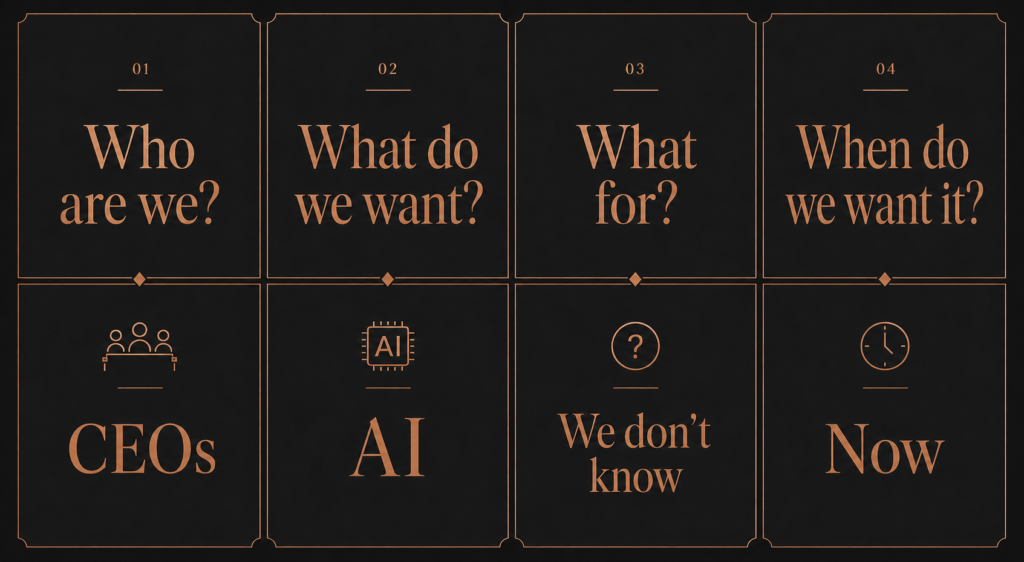
If this joke feels familiar, you are not alone.
Across SMEs and scale‑ups, leadership teams are increasingly asked to “do something with Artificial Interlligence”. The request often comes from exposure rather than intent: press coverage, competitor claims, board discussions, or investor conversations.
The expectation is urgency. The clarity is missing.
This is not an AI problem.
It is a governance and decision problem.
When AI becomes a substitute for strategy
In many organisations, AI appears as a solution before the problem is clearly defined. The discussion jumps straight to tools, pilots or vendors, skipping the harder questions:
- What decision or activity are we actually changing?
- Who owns the outcome?
- What does “success” mean in business terms?
- What risks are we accepting by automating or delegating decisions?
Without this framing, AI initiatives become symbolic actions rather than strategic ones.
When this typically appears
This situation usually emerges when:
- leadership feels pressure to keep up with competitors
- cost‑reduction or productivity narratives dominate discussion
- boards request AI “direction” without a clear mandate
- technology conversations reach board level without context
The organisation moves fast — but not deliberately.
Why common responses fail
The most frequent reactions are:
- launching AI pilots with no ownership
- asking suppliers to “propose something AI‑based”
- running proof‑of‑concepts disconnected from operations
- assuming AI will “replace roles” without understanding workflows
These actions create activity, not clarity.
Worse, they often introduce:
- opaque dependencies on vendors or models
- unclear accountability for outcomes
- unmanaged risk exposure (legal, reputational, operational)
- long‑term commitments made under short‑term pressure
The real business risks behind the hype
AI decisions, once embedded, are difficult to reverse.
Poorly framed initiatives can lead to:
- automation of flawed processes
- delegation of decisions no one is prepared to stand behind
- erosion of internal capability
- confusion between experimentation and production
From a leadership perspective, the key question is not “can we use AI?” . It is “should we? and under which conditions?“
This is a decision support issue, not a tooling one.
What a governance‑led approach looks like
A sensible AI approach starts before technology:
- clarify decision ownership
- distinguish augmentation from replacement
- define acceptable risk boundaries
- assess organisational readiness (data, processes, accountability)
- align initiatives with business priorities
Only then does implementation make sense.
This is why AI should be treated as a board advisory topic, not a delegated experiment.
Is this about being cautious or being slow?
Neither. It is about being intentional. Speed without framing increases risk.
Do all organisations need an AI strategy?
No. But all organisations need clarity before making AI commitments.
When this deserves a conversation
If AI appears frequently in discussions but rarely in clear decisions, the organisation is reacting rather than leading.
The most effective first step is often a structured conversation, not a pilot.

Does this deserve a conversation?